What we measured, and what the labs found.
Nourie is clinically tested on the scalp and independently tested for the same contaminants the category is known for. Results below.
Two trials. Real wear. Measured scalps.
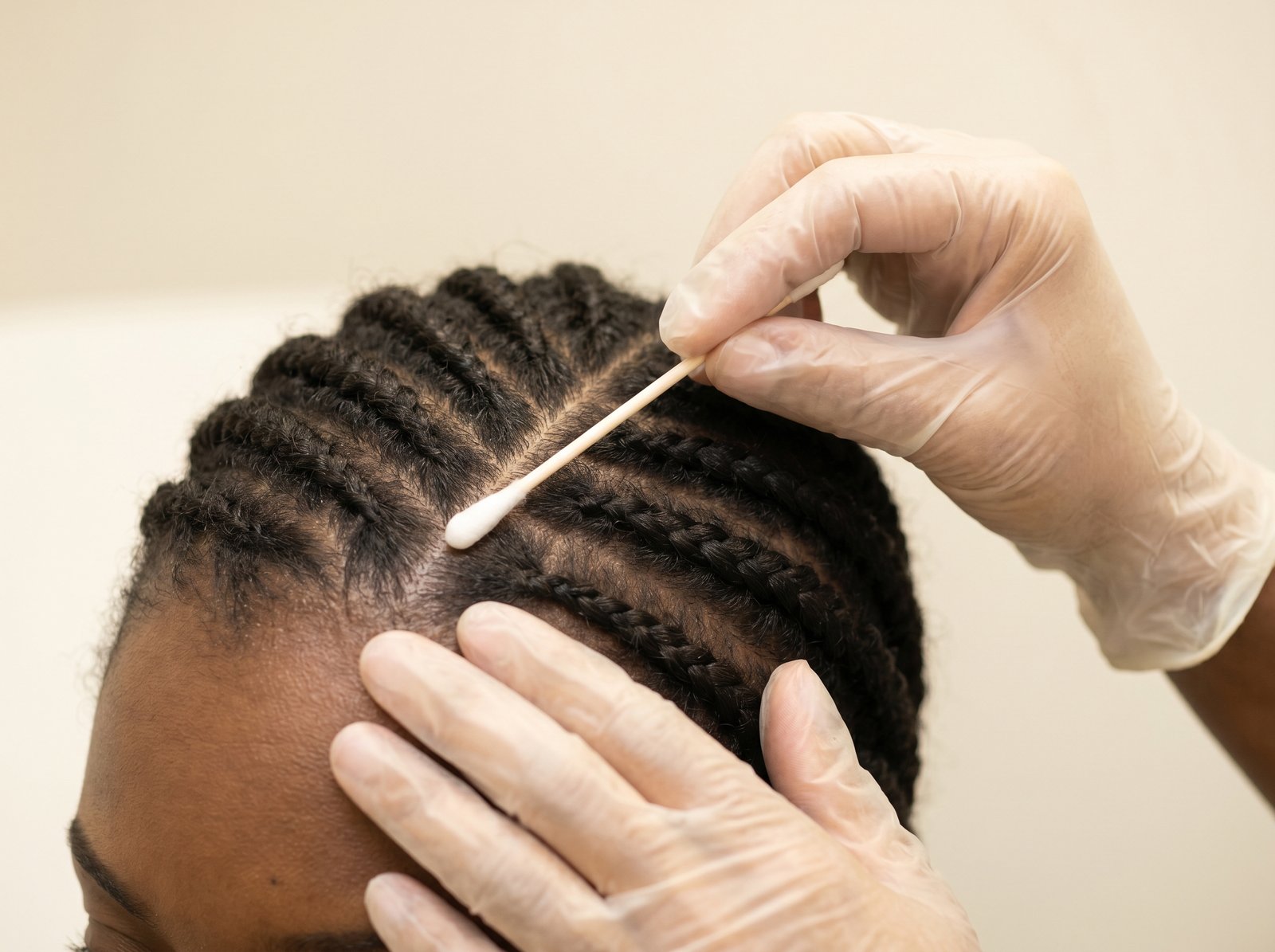
A "clinically tested" claim in this category usually means a patch of skin on a forearm or a back. A scalp under braid tension, covered for weeks, is a different exposure. We tested there.
Our protocol measured transepidermal water loss and standardized self-reported comfort, each against a leading modacrylic fiber, a vinyl chloride-based synthetic, and banked scalp swabs for inflammatory and microbiome analysis.
In IRB-approved testing, comfort and barrier measurements moved together on the Nourie side. On the comparator side they did not. What wearers reported feeling corresponded to what their skin was doing.
68
Participants across two clinical studies
Days 0, 1, 3, 7
Measurement points during braided wear
2 to 1
Preferred Nourie over a leading modacrylic fiber for comfort
Tracked together
Comfort and barrier response moved together on the Nourie side. On the comparator they did not.
The two studies.
Study one. Repeat-exposure tolerance.
Nourie was non-irritating, non-sensitizing, hypoallergenic, and dermatologist-tested, with no adverse events across fifty-eight participants. The test was a five-week repeat-insult patch protocol, the standard for irritation and sensitization under repeated skin contact, completed in 2024.
Study two. Scalp response during braided wear.
Participants preferred Nourie two to one for comfort. The Nourie side lost less moisture. Self-reported comfort correlated with transepidermal water loss on the Nourie side, with statistical significance, and did not on the comparator side.
Those results come from a double-blind, controlled comparison run in 2024. Ten participants completed the protocol. Each wore Nourie on one side of her head and the comparator on the other, with a section between braided in her own hair alone, no extension fiber, as the control. Measurements were taken at installation and on days 1, 3, and 7, with participants self-swabbing weekly for two further weeks.
Measured: transepidermal water loss for barrier function, scalp imaging, and a standardized comfort questionnaire. Collected and banked for analysis: scalp swabs for IL-6 and IL-8 by ELISA, and for 16S rRNA sequencing of the scalp microbiome.
Next.
A Phase 2 efficacy trial is IRB-approved and in development.
Tested for what the category keeps failing on.
Consumer Reports found carcinogens, heavy metals, or volatile organic compounds in every braiding hair product it tested in 2025 and 2026. We submitted Nourie fiber to SGS for the same categories, 75 analytes in total.
Not detected across every compound tested.
- Volatile organic compounds (70 compounds)
- Not detected
- Mercury, antimony, arsenic
- Not detected
- Lead (Prop 65 limit 100 mg/kg)
- Not detected
- Cadmium (Prop 65 limit 300 mg/kg)
- Not detected
SGS Test Report No. GZHL260602820301SD (PDF), June 25, 2026. Passes California Proposition 65 for lead and cadmium.
Lead · Cadmium · Mercury · Arsenic · Antimony · 1,1-Dichloroethane · 1,1-Dichloroethylene · 1,1,1-Trichloroethane · 1,1,1,2-Tetrachloroethane · 1,1,2-Trichloroethane · 1,1,2,2-Tetrachloroethane · 1,2-Dichloroethane · 1,2-Dimethoxyethane · 1,2,3-Trichloropropane · 1-Methyl-2-pyrrolidone · 2-Ethoxyethanol · 2-Ethoxyethyl acetate · 2-Methoxyethanol · 2-Methoxyethyl acetate · 2-Methoxypropyl acetate · 2-Phenyl-2-propanol · Acetophenone · Benzaldehyde · Benzene · Bis(2-methoxyethyl) ether · Carbon disulfide · Carbon tetrachloride · Chloroform · Cyclohexane · Cyclohexanone · Dichloromethane · N,N-Dimethylacetamide · N,N-Dimethylformamide · Ethylbenzene · Formamide · Furan · Hexachloroethane · Isophorone · Methyl ethyl ketone · 1-Bromopropane · n-Hexane · Naphthalene · Nitrobenzene · o-Cresol · Pentachloroethane · Styrene · Triethylene glycol dimethyl ether · Tetrachloroethylene · o-Xylene · Toluene · Trichloroethylene · Xylene isomers · m,p-Xylene · n-Butyl acetate · Ethanol · Ethyl acetate · Phenol · Acetone · Tetrahydrofuran · cis-1,2-Dichloroethene · trans-1,2-Dichloroethene · p,m-Cresol · Chloroethane · trans-1,3-Dichloropropene · Dibromochloromethane · Bromodichloromethane · Bromoform · 1,4-Dioxane · Dibromomethane · Hexachlorobutadiene · Dimethyl carbonate · Methylcyclohexane · Dimethyl sulfoxide · 1,4-Dichlorobenzene · 1,2-Dichloropropane
Seventy-five analytes tested by SGS. None detected. Report No. GZHL260602820301SD, June 25, 2026