What's actually in your braiding hair.
Plain language, every claim sourced. What the material is, what it does, and what we found when we tested our own.
Two industrial chemicals: vinyl chloride (VY-nul KLOR-ide) and acrylonitrile (uh-KRIL-oh-NY-trile).
The WHO's cancer agency classifies both as known human carcinogens. It is the same chemical family used to make pipe, flooring, and shower curtains.
They never put it on the packaging. They were never required to.
What that does to your scalp.
Most braiding hair is made from PVC-based modacrylic, a material never designed for prolonged dermal contact. Under heat, sweat, friction and UV, those surfaces shed plasticizers and chloride compounds that wear down the scalp barrier over time.
No one has measured how much of that reaches the scalp across a full install. That is the reason we ran clinical trials instead of making a claim.
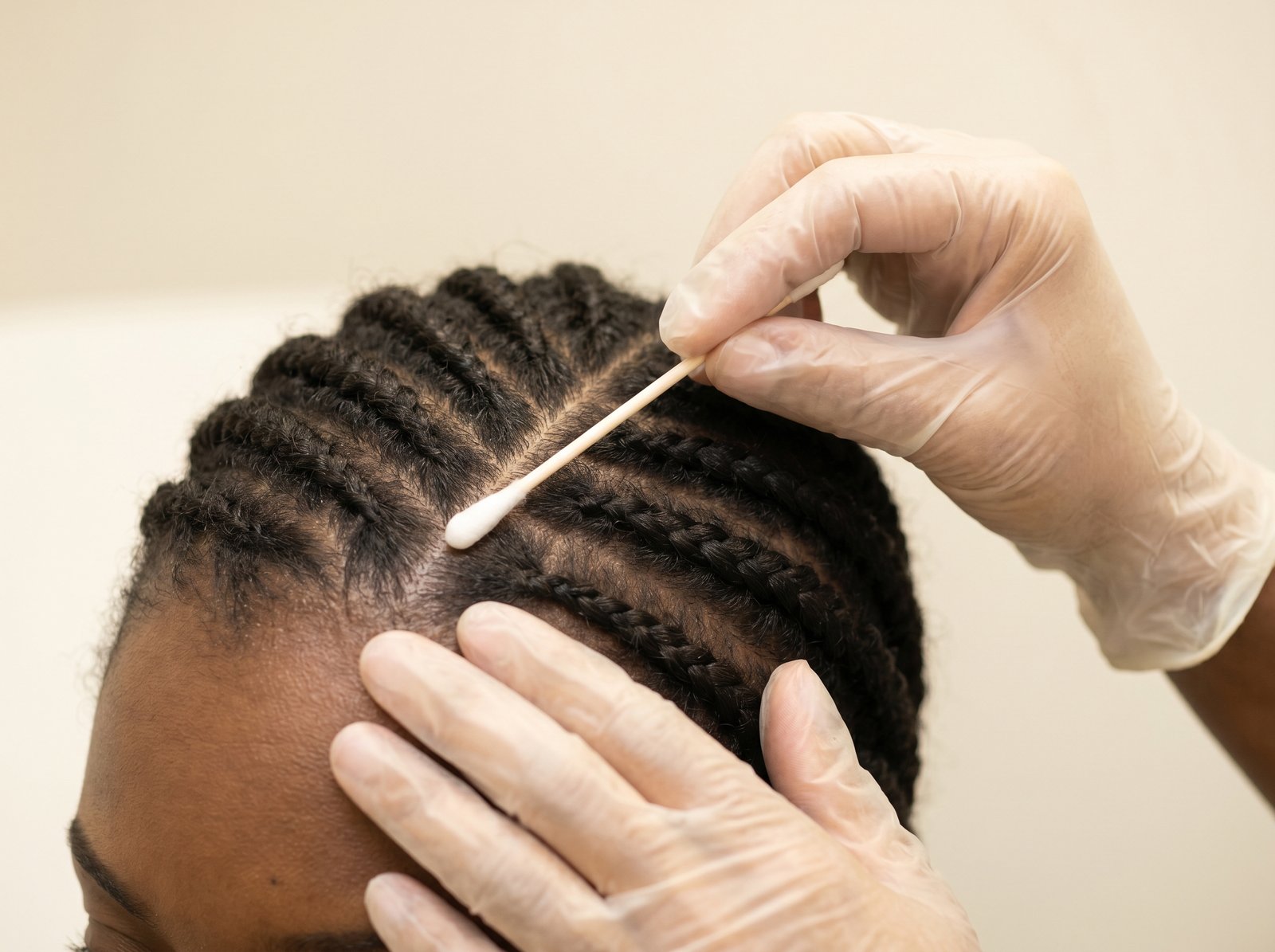
A rinse is not a redesign.
The industry's answer was to normalize the irritation: soak the hair in apple cider vinegar before installation. It is an acid soak at pH 2.5 to 3.5. Your scalp sits closer to 5.
The rinse lifts some surface residue, which is why day one feels better. What the acid does to the fiber itself is undocumented. By week two the same chemistry is back against your scalp.
The problem is not on the surface. It is the material.
We had our fiber tested for the same things.
Consumer Reports tested 40 braiding hair products across human, synthetic, and plant-based hair in 2025, and again in 2026. Every one tested positive for at least one harmful substance. We sent Nourie to SGS for the same categories, 75 analytes across volatile organic compounds and heavy metals including lead and cadmium. None were detected.
The full panel, the report number, and both clinical studies are on the clinical page.
The questions you came here with.
The questions people ask when they finally start looking for information.
Why does my braiding hair itch?
It isn't your scalp. Almost all braiding hair is made from industrial fiber that sheds plasticizers and chloride compounds under heat and sweat. Weeks of that against skin wears down the barrier. The itch is the barrier telling you.
Is braiding hair toxic?
Consumer Reports tested 40 products in 2025 and 2026, across synthetic, plant-based, and human hair. Every one contained at least one of carcinogens, heavy metals, or volatile organic compounds. Lead was in 38.
Should I switch to human hair?
Human hair was the worst category for lead in the 2026 test. Human doesn't mean clean.
Does 'hypoallergenic' on the pack mean anything?
Not on its own. It's a word, not a test. Ask which study, on whom, and where the results are.
Does apple cider vinegar fix it?
It lifts some surface residue, which is why day one feels better. By week two the same material is back against your scalp. A rinse is not a redesign.
What to do now.
Read the pack for a fiber name.
Kanekalon and Toyokalon are modacrylic. Polypropylene and polyethylene are the plastics in packaging and rope. “Synthetic” with no name is PVC. None of them were made for skin.
Treat “clean” as a claim, not a fact.
Pre-washed, pre-rinsed, odorless, clean: each one describes something done to the fiber after it was made, which tells you it needed doing. A fiber made for skin doesn't need washing before it touches yours.
Ask your braider one question.
“What fiber is this, and has it been tested on skin?” You'll know a good braider quickly, because she'll want the answer as much as you do. If she doesn't, that tells you something too. She's been choosing the material on your head for years. It's fair to ask what it is.
Don't switch to human hair for safety.
Human hair was the worst category for lead in the 2026 Consumer Reports test.
If your scalp is reacting, take the braids down.
A rinse buys a day. If the skin is broken, weeping, or the bumps are spreading, the install comes out and a dermatologist looks at it.
Ask for Nourie by name.
When it's on a pack, that fiber has been tested on the scalp. Until then, tell us where you'd want to find it, and we'll tell you where it lands first.
Where to find it.
Nourie is the fiber inside braiding hair sold by other brands, with the testing behind it. To find out which brands carry it, ask us and we will point you to them.